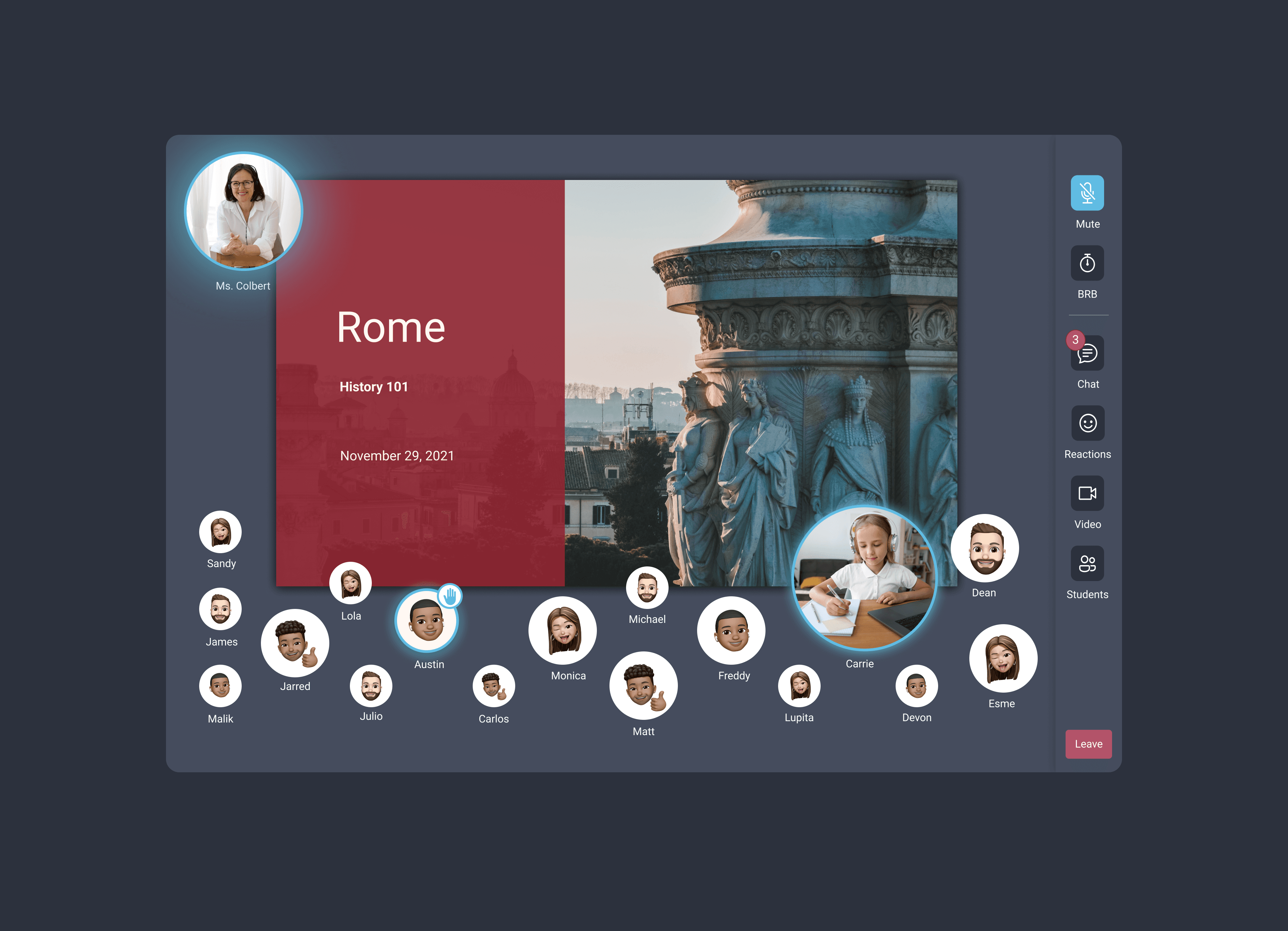
Avagab
A concept online learning platform designed to support healthier, more engaging virtual classrooms for grade-school students and teachers.
This project was completed as part of an MIT human-centered systems design course during COVID-era remote learning. I led product and UX design, applying human factors research and cognitive load theory to explore how synchronous online learning could better support students and educators.
Problem
Most online learning relied on tools built for corporate meetings, not classrooms. Constant self-view, prolonged eye contact, and fragmented interfaces increased cognitive load and social fatigue for students, while teachers lacked meaningful signals to understand engagement or adapt instruction in real time.
Outcome
The final prototype introduced a human-centered alternative to traditional video classrooms, using avatar-based presence, engagement insights, and adaptive pacing to reduce fatigue and encourage natural participation, demonstrating how human systems thinking can improve focus and instructional effectiveness in remote learning.
University
MIT
Role
Collaborators
Platform(s)
Web App
Year
2021

My role
I worked on this project as part of a 4-person team in an MIT human-centered systems design course. The team worked collaboratively across all phases of the project, including user research, persona development, applying human factors principles, and solution design. I co-led prototyping with another designer on the team, translating our research insights into visual designs and interactive prototypes that we validated through usability testing with students and teachers.
Understanding the problem space
When schools rapidly shifted to remote learning during the pandemic, most classrooms were built on top of general-purpose video conferencing tools rather than platforms designed for education. Popular tools like Zoom, Microsoft Teams, and Google Meet enabled fast adoption and basic connectivity, but they were optimized for adult, professional meetings rather than sustained learning environments for children. As a result, students and teachers were forced to adapt to tools that did not reflect how classrooms actually function.
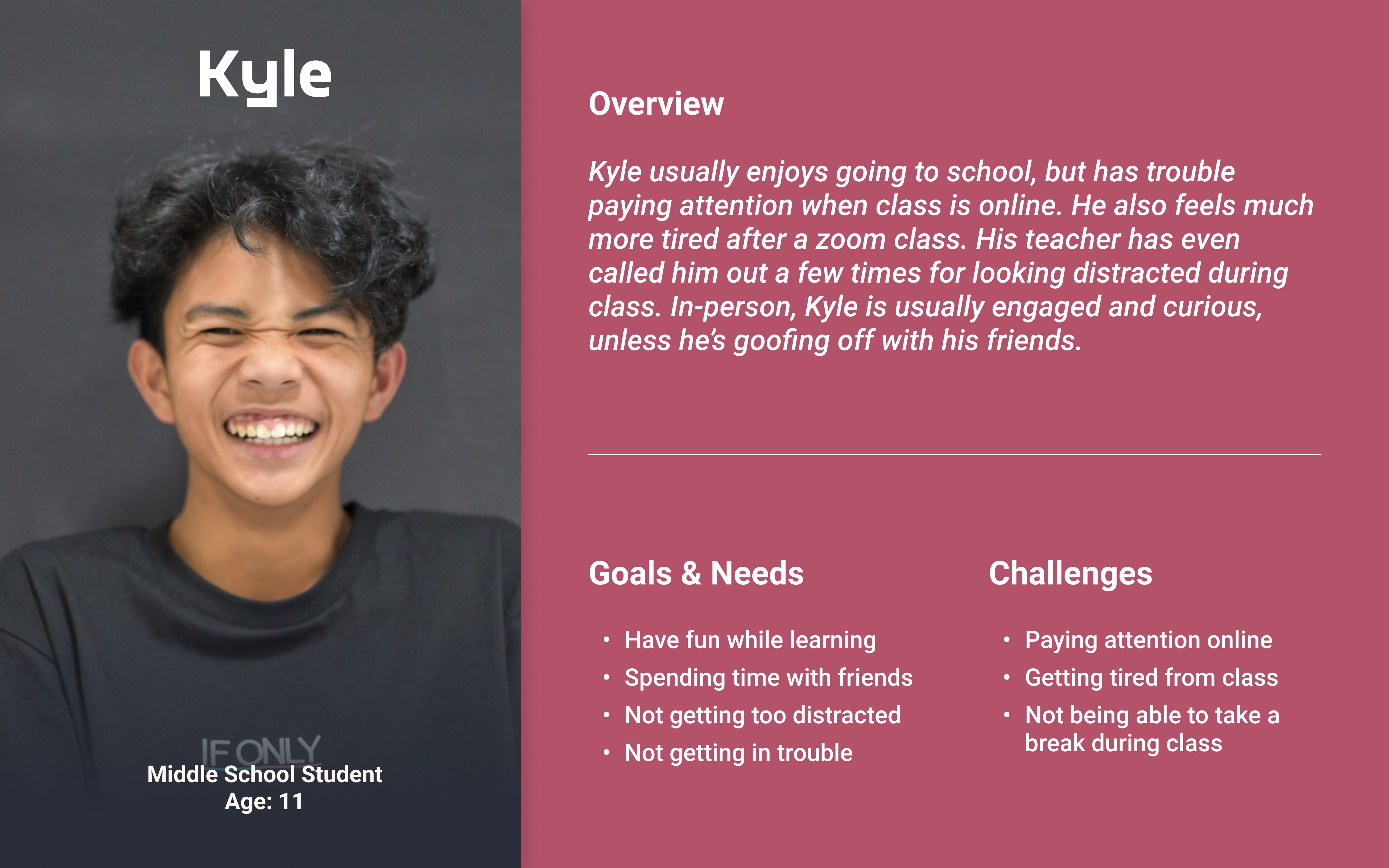
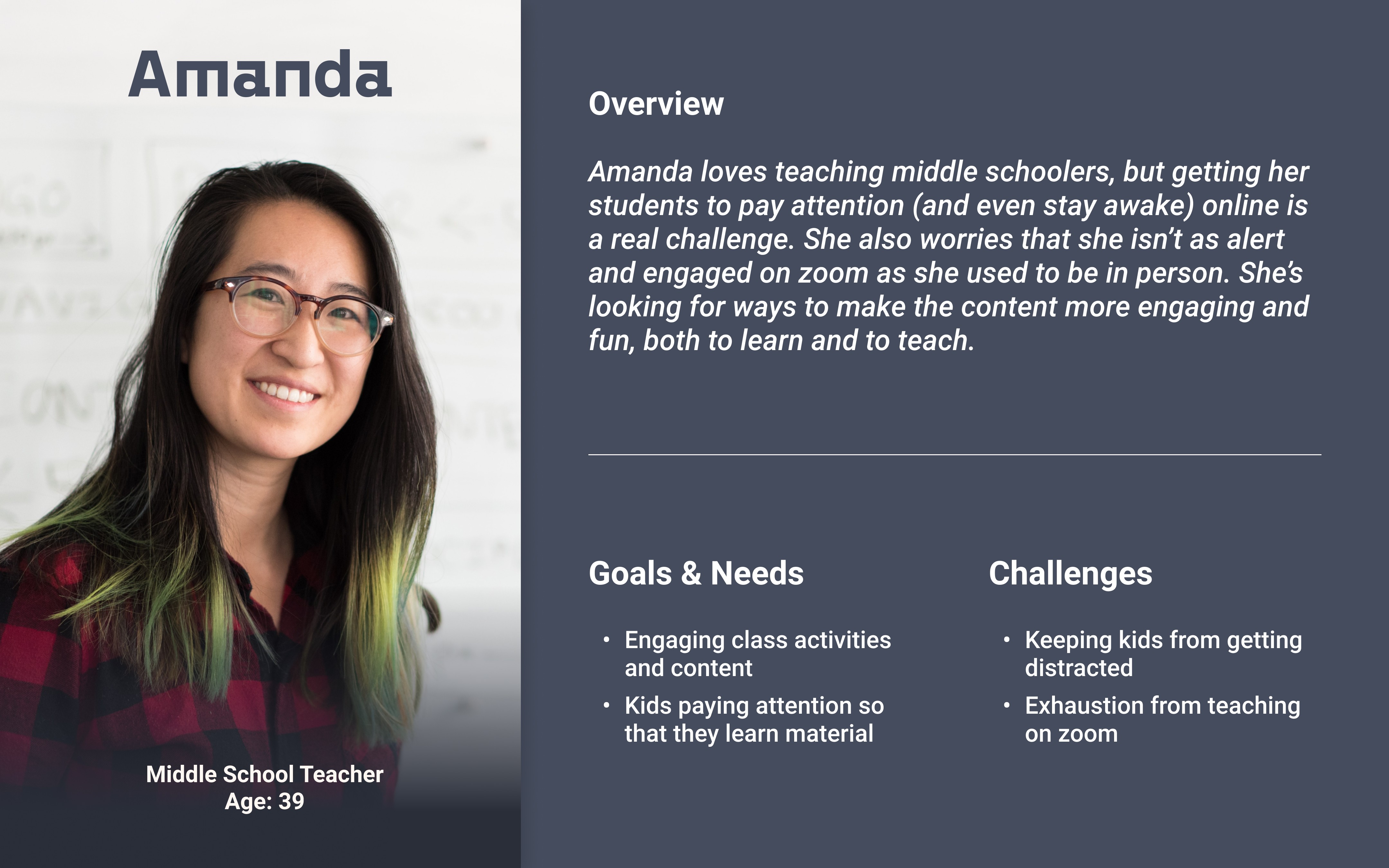
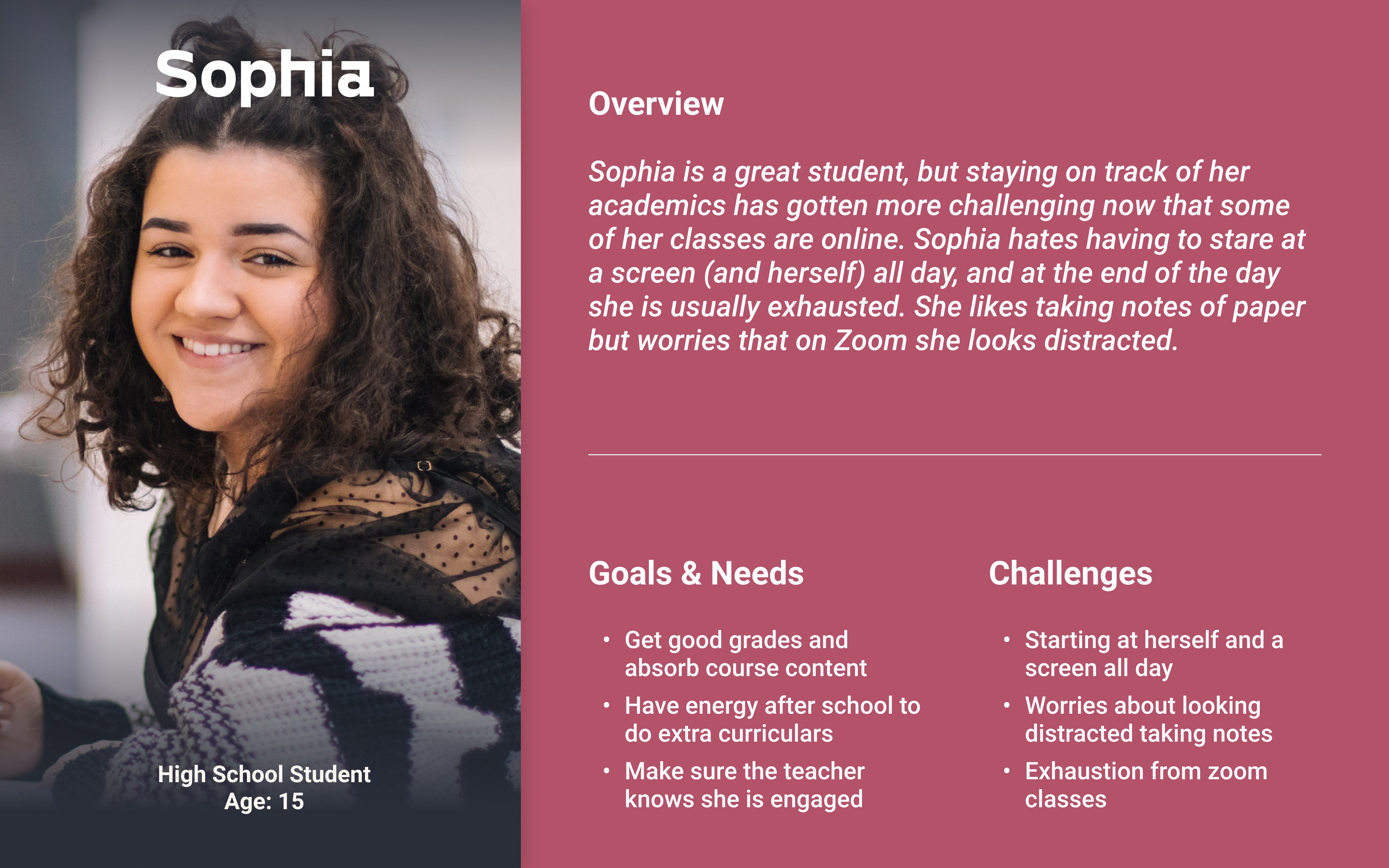
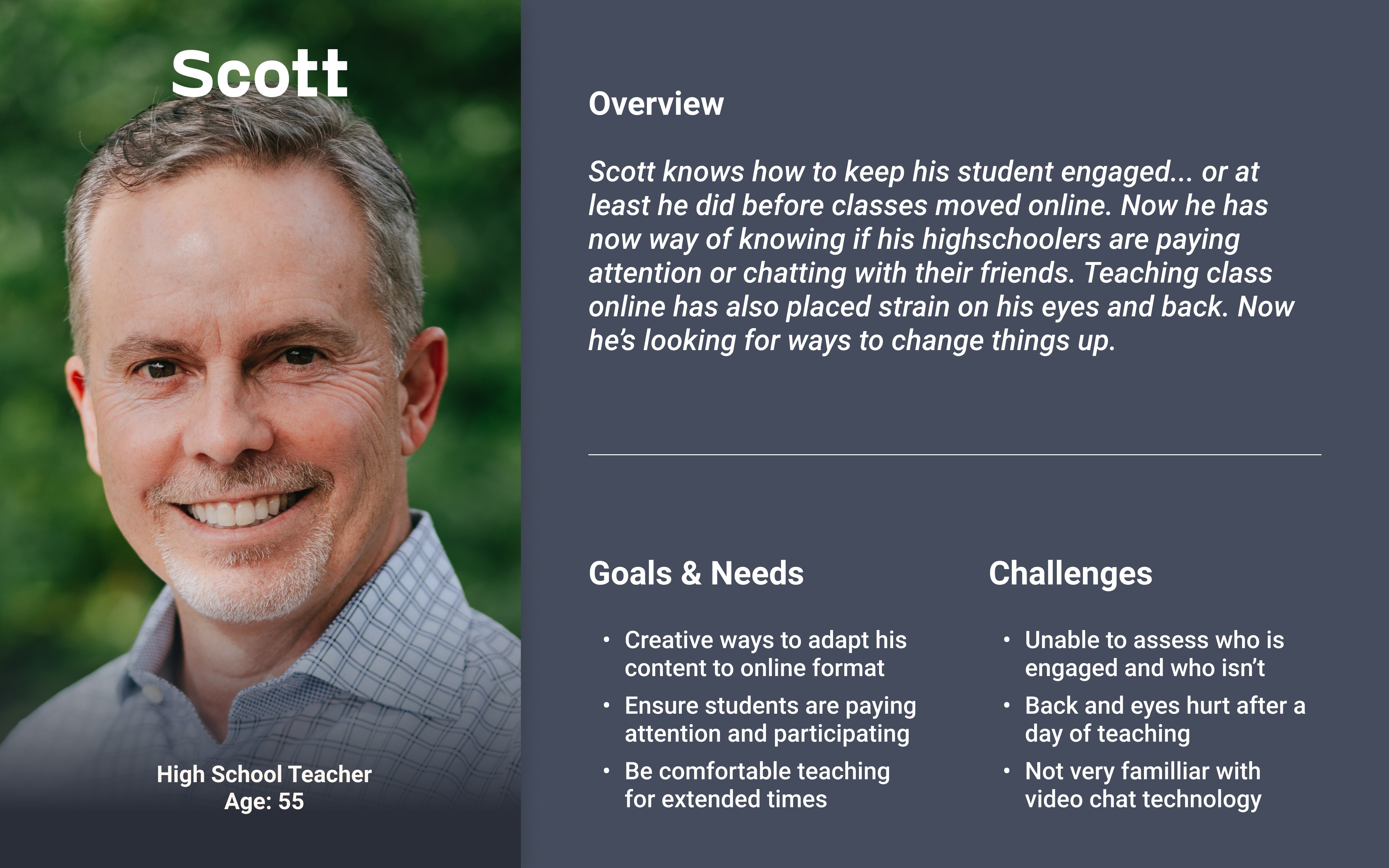
To ground the problem in real classroom behaviors, we developed four representative personas spanning student and teacher roles, reflecting common needs and challenges across remote and hybrid learning environments.
What worked with current platforms
Where they fell short
As a result, students experienced increased cognitive load and disengagement, while teachers struggled to read the room, adapt instruction, and support equitable participation. This gap revealed an opportunity to rethink synchronous online learning through a human-centered, classroom-first lens rather than extending tools designed for meetings.
Goals and success signals
The goals for Avagab focused on addressing the distinct but interconnected needs of students and teachers within synchronous online learning environments.
Reduce social pressure and cognitive overload during live classes
Support focus and participation without requiring constant camera presence
Make virtual classrooms feel safer, more comfortable, and less performative
Students participate more frequently without relying on always-on video
Reduced visible signs of fatigue and disengagement during sessions
Students report feeling less self-conscious and more focused on learning
Better understand student engagement in real time
Adapt pacing and instruction without relying solely on visual cues
Support inclusive participation across in-person and remote students
Teachers can quickly identify attention and participation patterns more easily
Instructional adjustments (breaks, activities, pacing) feel more intentional rather than reactive
Increased participation from students who were previously less visible
These goals and success signals guided design decisions throughout the project, ensuring solutions prioritized real classroom needs over meeting-centric conventions.
Constraints and complexity
Avagab explored a problem space with no established learning-first blueprint, requiring design decisions that balanced human factors, classroom dynamics, and real-time interaction.
Key constraints
Designing for children in sustained video environments
Interfaces needed to reduce cognitive load and social pressure while remaining simple, intuitive, and age-appropriate for extended use.
Supporting real-time, synchronous learning
The platform needed to enable fluid classroom interaction without introducing additional UI complexity or distracting from instruction.
Limited visibility into engagement
Teachers required meaningful signals beyond camera presence, without relying on invasive monitoring or constant visual attention.
Hybrid classroom dynamics
Designs needed to support equitable participation across in-person and remote students without privileging one group over the other.
Translating research into usable interaction patterns
Human factors and cognitive science insights needed to be embedded into the experience in ways that felt natural, not academic or disruptive.
Early insight
Early research revealed that many challenges in virtual classrooms were caused by how existing tools structured interaction rather than a lack of functionality. Constant on-camera presence increased self-consciousness and fatigue for students, participation required high cognitive effort, and teachers lacked the engagement cues they rely on in physical classrooms. These insights shifted the focus from recreating in-person learning online to designing a virtual classroom experience that better supports natural participation, attention, and teaching flow.
Design decisions and solutions
Avagab was designed as a healthier, more human alternative to traditional video classrooms, grounded in cognition, ergonomics, and attention science. Rather than recreating meeting-style video calls, the solution focused on lowering the social and cognitive cost of participation while giving teachers better signals to guide instruction in real time.
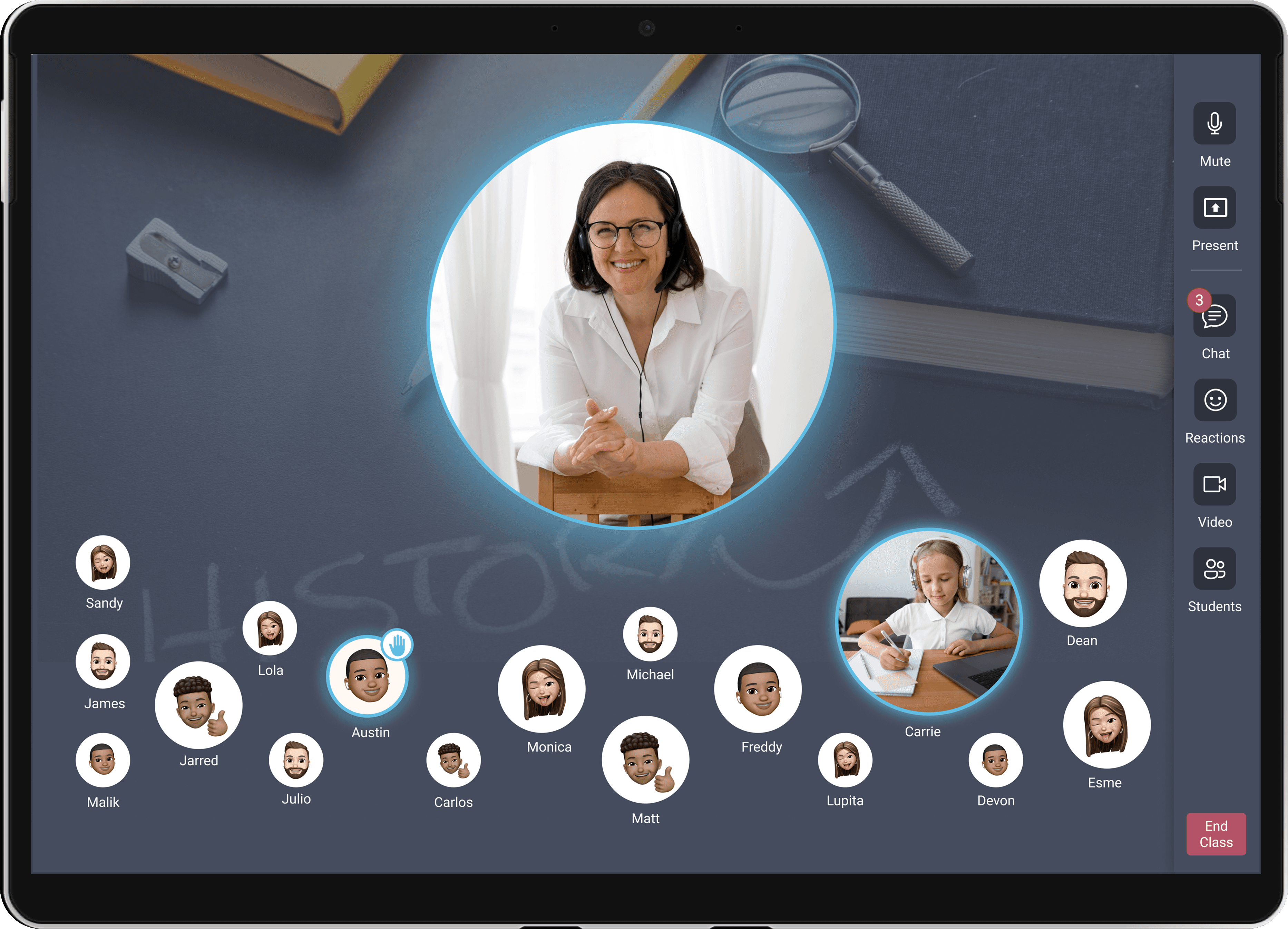
Avatar-based presence
To reduce self-consciousness and camera fatigue, Avagab replaces constant live self-view with customizable avatars that activate only when a student speaks.
This decision decouples participation from continuous visibility, allowing students to remain present without the pressure of being watched. By shifting attention away from self-monitoring and toward instruction, avatars help reduce social anxiety, eye-contact pressure, and cognitive switching costs during live sessions.
Key design decisions
Removed always-on self-view to reduce self-focused attention
Maintained a sense of presence without requiring constant visibility
Activated avatars only during speaking to reinforce participation cues
Engagement analytics
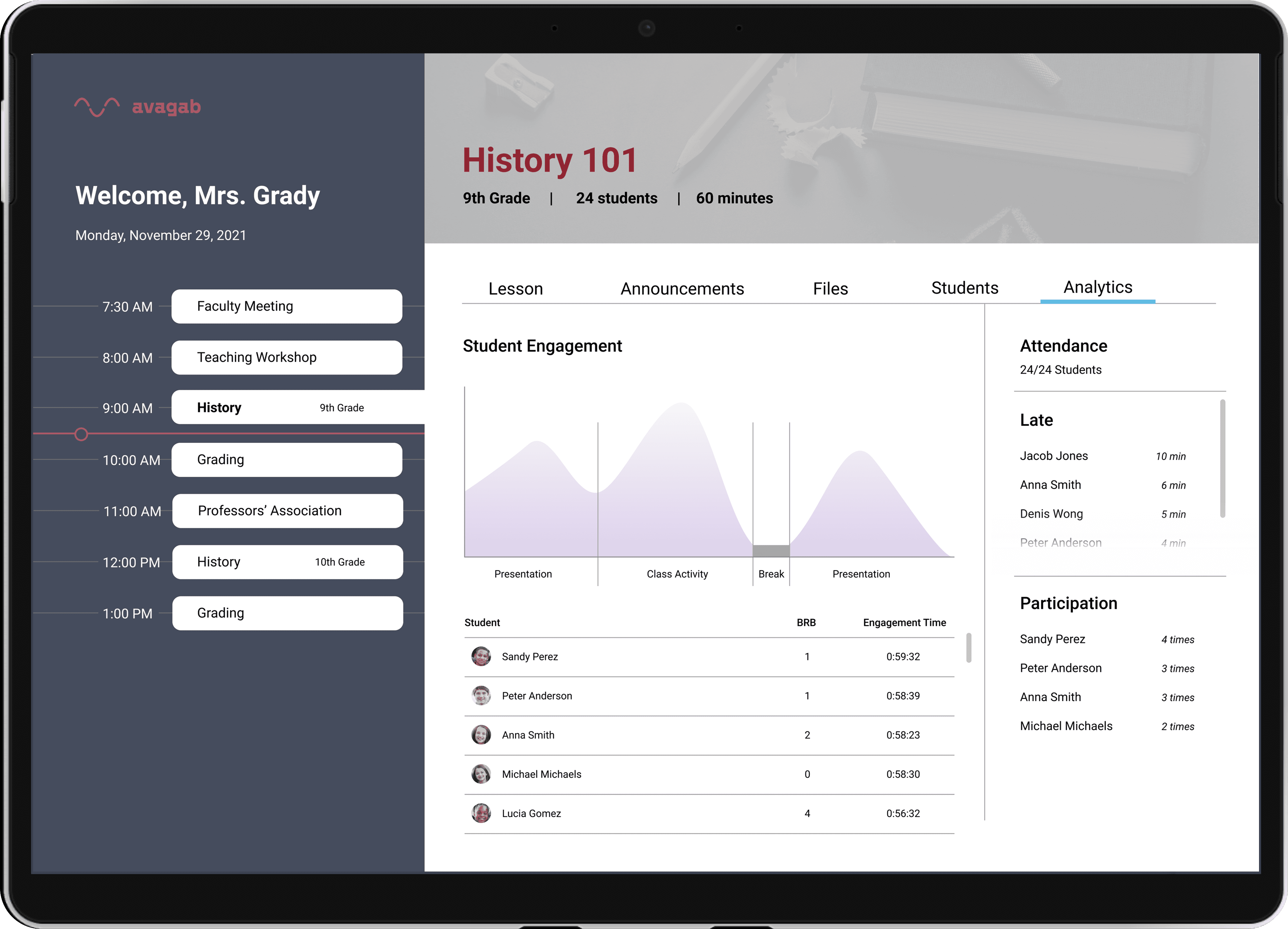
Teachers often rely on patterns, not just faces, to understand how a class is doing. Avagab provides lightweight, real-time insights into participation, speaking time, and engagement trends to support this need.
Rather than surveilling individual students, engagement signals surface class-level patterns that help teachers recognize when attention is dropping, when participation is uneven, or when pacing adjustments may be needed.
Key design decisions
Focused on class-level trends instead of individual monitoring
Prioritized interpretability over granular data
Designed signals to support teaching judgment, not replace it
Gamified learning activities
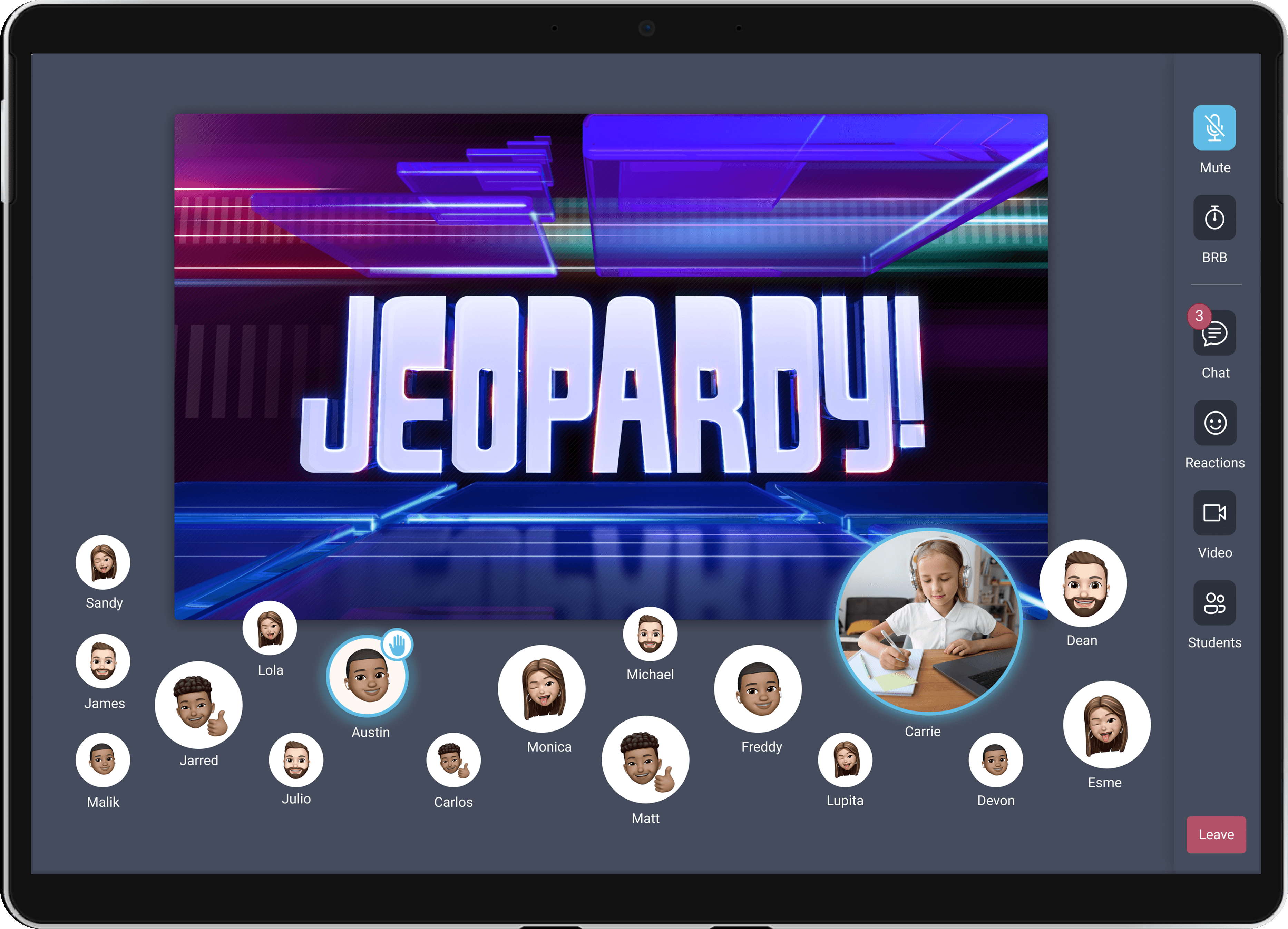
To counter passive listening and monotony, Avagab includes built-in templates such as quizzes, polls, timers, and collaborative mini-games.
These tools lower the barrier to interaction and give teachers simple ways to vary instruction, increase energy, and encourage broader participation without introducing complex setup or workflow overhead.
Key design decisions
Embedded activities directly into the classroom flow
Minimized setup time to support spontaneous use
Designed interactions to encourage participation from quieter students
Adaptive break recommendations
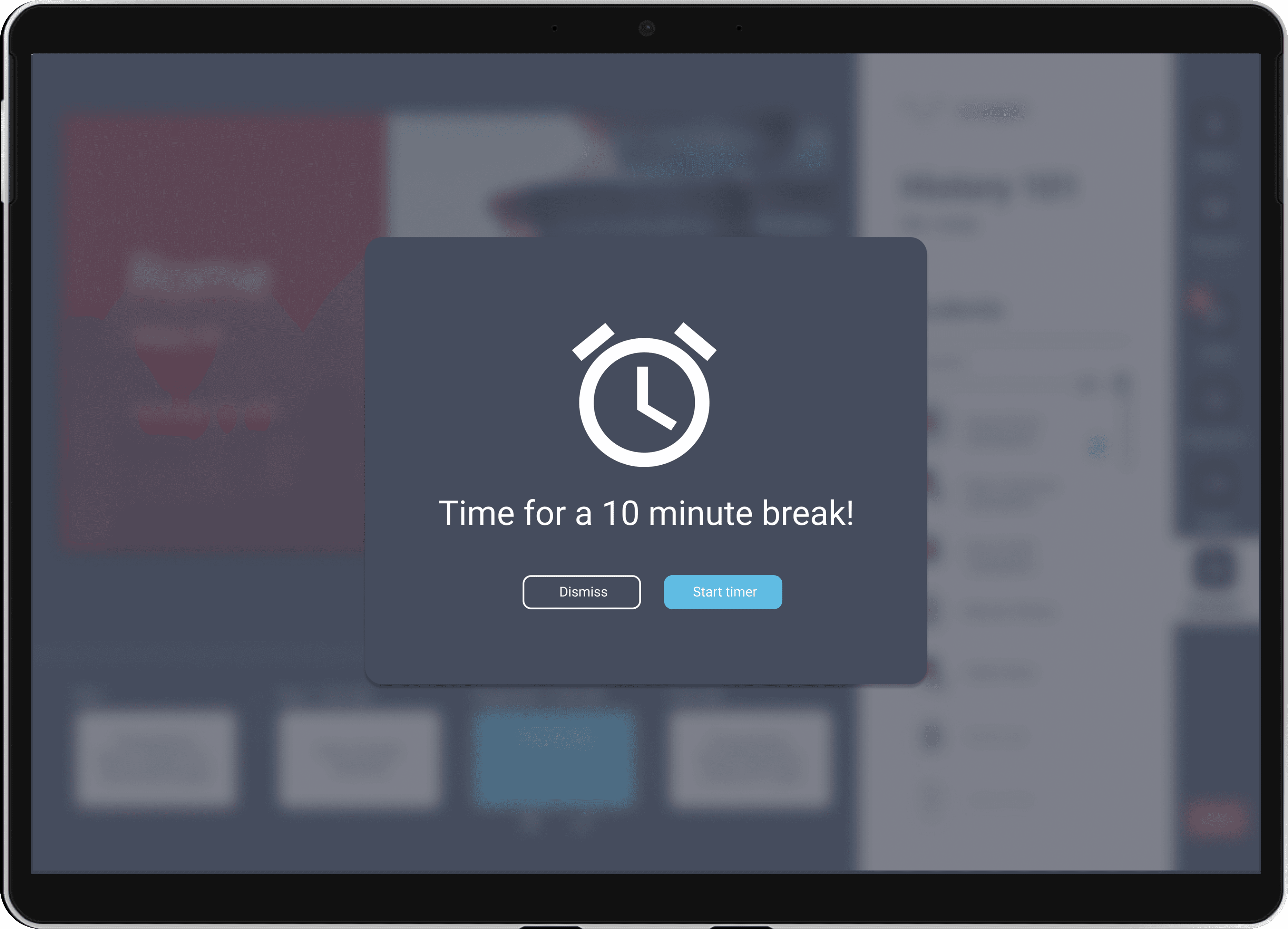
Sustained attention fluctuates naturally, especially in long virtual sessions. Using human-factors principles, Avagab detects collective dips in attention and suggests timely stretch breaks or micro-pauses.
These prompts support healthier pacing without disrupting instruction, helping reduce cognitive fatigue while encouraging movement and reset moments during extended learning blocks.
Key design decisions
Treated attention as a shared, dynamic state
Used suggestions rather than forced interruptions
Designed prompts to feel supportive, not prescriptive
Designing for hybrid classrooms
Avagab considered the realities of hybrid learning environments where remote and in-person students coexist. Design decisions focused on adaptive visibility and participation cues that keep remote students included in the classroom flow without requiring constant manual intervention from teachers.
Final solution overview
The final Avagab concept brings together research, constraints, and design decisions into a cohesive, classroom-first experience designed to support healthier participation and more effective teaching during live online instruction. Rather than centering the experience around constant video presence, Avagab reframes the virtual classroom around attention, interaction, and teaching flow, creating an environment that better aligns with how students and teachers naturally engage in learning.
Student experience walkthrough
The student experience focuses on lowering the social and cognitive cost of participation while maintaining a clear sense of presence in the classroom. Students join sessions without the pressure of always-on self-view, participate through avatar-based presence, and engage in activities that encourage interaction without distraction or fatigue. This walkthrough highlights how Avagab supports focus, comfort, and natural participation throughout a live class.
A video walkthrough of the student experience is shown below.
Teacher experience walkthrough
The teacher experience centers on facilitating instruction with clearer engagement signals and more intentional pacing. Teachers are able to monitor participation patterns, introduce activities, and adjust the flow of a session using lightweight, real-time insights rather than relying solely on visual monitoring. This walkthrough demonstrates how Avagab supports instructional decision-making without adding complexity or cognitive overhead.
A video walkthrough of the teacher experience is shown below.
Outcome and impact
Avagab was developed as a concept prototype and validated through usability testing with students and teachers during remote learning. The project received recognition within MIT's Integrated Design & Management program and demonstrated how human-centered systems thinking could improve virtual classroom experiences.
What we delivered
Complete end-to-end prototype for student and teacher experiences
Validated design through usability testing with 15+ students and educators
Comprehensive research synthesis including personas, journey maps, and cognitive load analysis
Demonstration of applied human factors principles in educational technology
Concept validation
Through informal testing and feedback sessions with students and teachers, we gathered initial reactions to the core concepts:
Avatar-based presence resonated with students who felt fatigued by constant camera-on requirements
Teachers expressed interest in engagement signals beyond visual monitoring
Adaptive break recommendations aligned with reported patterns of attention loss during long sessions
The concept demonstrated potential for reducing social pressure while maintaining classroom connection
As a prototype, the work focused on exploring how human-centered design principles could improve virtual learning environments rather than validating measurable outcomes.
System design and human factors
Avagab was intentionally designed using core human systems engineering principles to ensure the experience supported attention, comfort, and sustained engagement in live learning environments.
Key principles applied
Cognitive load
Reducing visual clutter, constant self-view, and social vigilance to help students focus on instruction rather than self-monitoring.
Perception and attention
Using salience, hierarchy, and pacing to guide focus and reduce unnecessary cognitive switching during live sessions.
Ergonomics
Supporting movement and timed breaks to reduce fatigue and encourage healthier physical behavior during extended virtual classes.
Mental models
Structuring interactions and layouts around familiar classroom workflows to reduce learning overhead for both students and teachers.
Usability variables (Wickens)
Designing for learnability, efficiency, memorability, error prevention, and overall satisfaction within a real-time system.
This foundation ensured that design decisions were grounded not just in usability, but in how people perceive, process, and sustain attention in complex digital environments.
Reflections & key learnings
Building Avagab taught me to apply human factors frameworks to product design and translate academic research into actionable decisions. The project pushed me beyond surface-level UX patterns to design a real-time system balancing cognition, ergonomics, and classroom dynamics.
Working within the constraints of a concept prototype reinforced the importance of grounding design in research even without launch validation. We couldn't measure real behavioral change, but we could test whether our core assumptions resonated with actual students and teachers.
This project established foundational skills in systems thinking, cognitive load management, and designing for complex human behaviors that I've applied throughout my work at Dell and Hilton. The human-centered frameworks I learned here directly informed how I approach enterprise UX, particularly designing payment systems and internal platforms that balance technical constraints with human performance.