Payments Integration and Optimization
Designing scalable digital payment experiences across Hilton’s checkout and wallet ecosystem
I led the design of Hilton’s customer facing payments enhancements across two core surfaces, Checkout and Wallet. The work focused on establishing a scalable foundation for integrating new payment methods, including Apple Pay and Google Pay, while optimizing the Wallet experience to improve clarity, flexibility, and usability across web and mobile platforms.
Problem
Hilton’s payment experiences supported a wide range of guests and booking scenarios, but key payment flows lacked modern payment options and clear, consistent entry points. This created friction across both Checkout and Wallet and limited flexibility within a complex, enterprise payments ecosystem.
Outcome
The redesigned Checkout and Wallet experiences introduced modern digital payment integrations and streamlined payment flows, reducing friction and aligning Hilton’s customer facing payments with broader enterprise payments strategy and future scalability.
Company
Hilton Corporation
Role
Collaborators
Platform(s)
Mobile and Desktop
Year
2024
My role
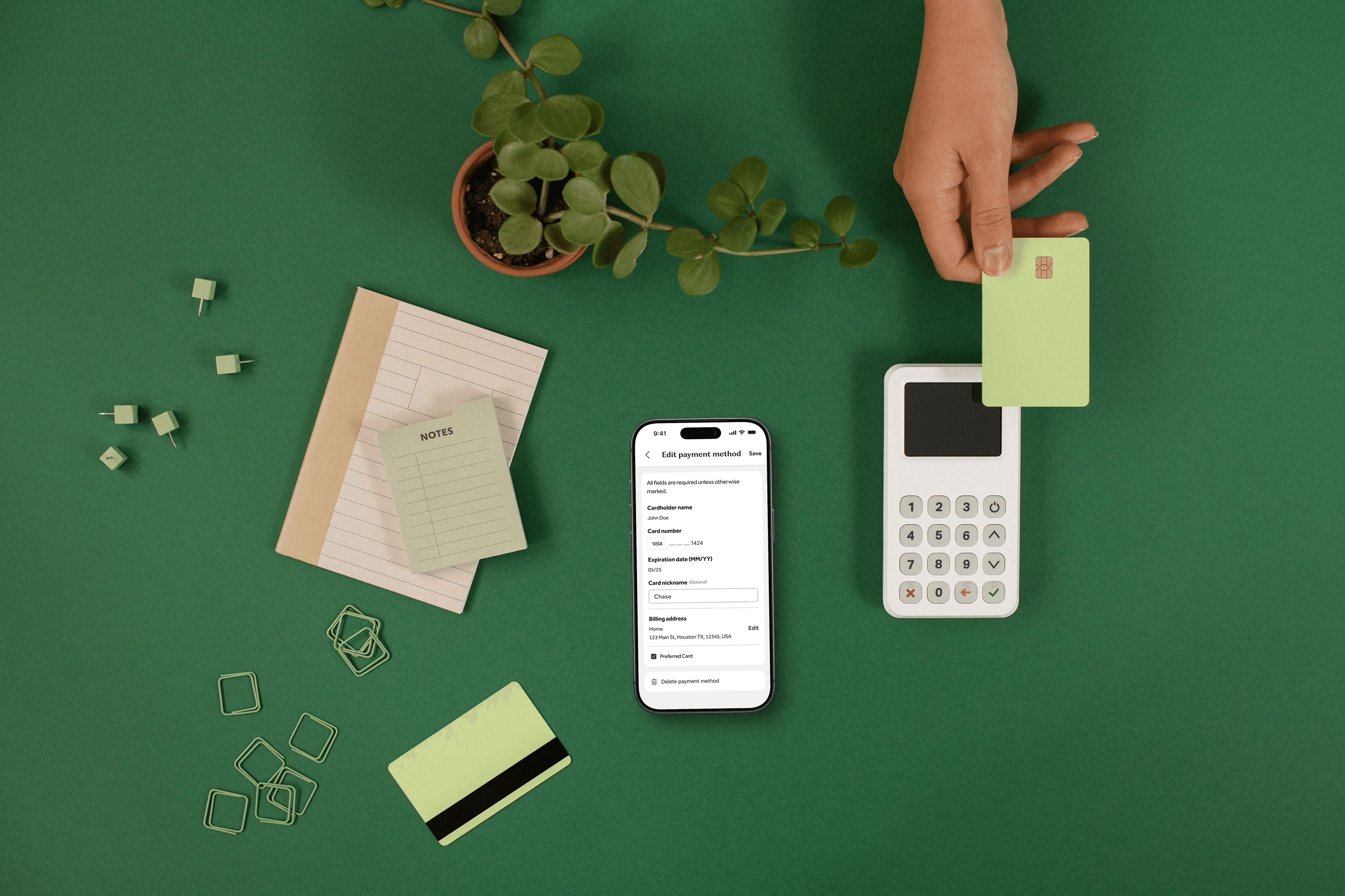
I led all UX design work for this project across checkout and wallet surfaces, owning the end-to-end experience from discovery through delivery. I partnered with a UX researcher to conduct usability testing across web and mobile platforms, and collaborated closely with Product, Engineering, Legal, Accessibility, and third-party partners (Apple, Google) to ensure technical feasibility, platform compliance, and brand consistency. I delivered detailed design specifications and engineering handoff documentation for wallet enhancements that were pending implementation at the time of my departure.
Understanding the system
Hilton’s customer facing payments ecosystem spans multiple surfaces, platforms, and user contexts, all supported by a shared enterprise payments infrastructure. Checkout and Wallet serve distinct user needs, but are tightly connected through underlying payment services, data flows, and compliance requirements.
Checkout is a transactional, time sensitive experience where guests expect speed, trust, and flexibility when completing a booking. It must support multiple payment methods, devices, regions, and currencies, while integrating cleanly with enterprise systems and third party providers.
Wallet is a persistent, account level surface that allows guests to manage saved payment methods and related payment preferences. While less time critical than Checkout, it plays a key role in reducing friction by enabling faster, more confident transactions across Hilton’s digital experiences.
Designing within this system required balancing immediate usability improvements with long term scalability, ensuring new payment integrations and Wallet optimizations worked cohesively across both surfaces without introducing inconsistency or technical debt.
Mobile platform context
During this work, Hilton’s mobile platform was transitioning from supporting separate platform-specific experiences (M2) to a unified mobile design system shared across iOS and Android (M3). The system needed to support both models in parallel, ensuring feature parity across platforms while transitioning toward a unified mobile experience.
As a result, solutions were designed to work across M2 and M3 implementations as well as web, requiring careful coordination to address platform gaps while aligning toward a shared long-term direction.
Below is a snapshot of Hilton’s pre existing Checkout and Wallet experiences across platforms prior to optimization.

Checkout and Wallet existed across multiple platforms, versions, and user states, including mobile and desktop experiences for both guests and logged in members. Each surface evolved independently over time, resulting in inconsistent patterns, duplicated logic, and fragmented payment experiences across the system.
Goals and success signals
This project balanced the needs of guests completing payment tasks with the business need for a scalable, compliant payments foundation.
These goals and success signals informed design decisions throughout the project and established clear criteria for evaluating success.
Constraints and complexity
This project operated within a mature enterprise payments ecosystem with strict technical, regulatory, and operational constraints. Design decisions needed to account for both immediate usability improvements and long-term platform stability across Checkout and Wallet.
Key constraints
Enterprise payments infrastructure
Checkout and Wallet were supported by shared backend services and third-party providers, limiting the ability to introduce surface-level changes without coordinating across multiple systems and teams.
Compliance and risk considerations
All payment flows were subject to legal, security, accessibility, and regional compliance requirements, requiring close collaboration with Legal, Compliance, and Accessibility partners throughout the design process.
Global scale and variability
Payment experiences needed to support multiple regions, currencies, devices, and user states, including guests and logged-in members, across web and mobile platforms.
System consistency across surfaces
Checkout and Wallet served different user needs but relied on shared patterns and logic. Changes in one surface had implications for the other, increasing the importance of consistency and reuse.
Extensibility requirements
Payment integrations needed to be designed as part of a scalable framework, enabling future payment methods without introducing rework or fragmentation across the system.
Mobile platform fragmentation
Mobile platform fragmentation required solutions to work across parallel implementations while aligning toward a unified long-term direction, increasing coordination across design, engineering, and release timelines while limiting how quickly changes could be introduced.
Early insight
While Checkout and Wallet served different moments in the guest journey, the underlying issue was not feature specific but systemic. Payment experiences had evolved independently across surfaces and platforms, creating inconsistency and friction. Meaningful improvement required treating payments as a shared system rather than a set of isolated flows.
Focusing the work
Given the size and complexity of Hilton’s payments ecosystem, the work focused on high-impact workflows that balanced guest value, business priorities, and technical feasibility. Insights from user research, usability testing, and cross-functional input helped identify opportunities where improvements would meaningfully reduce friction while laying the foundation for future scalability.
How we focused the work
Prioritized workflows with direct impact on booking completion and payment flexibility
Focused on changes that could scale across platforms and surfaces
Balanced immediate improvements with longer-term platform investments
Design decisions and solutions
The design solutions focused on improving payment flexibility, clarity, and persistence across Checkout and Wallet, while ensuring all changes aligned with Hilton’s enterprise payments infrastructure and could scale over time. Rather than treating each update as an isolated enhancement, the work prioritized shared patterns and behaviors to create a more cohesive payments experience across surfaces.
Checkout: enabling modern payment methods
Apple Pay and Google Pay integration
Previously, Checkout did not support modern digital wallets, requiring guests to rely on traditional card entry and limiting payment flexibility during booking. To address this, Checkout was updated to support Apple Pay and Google Pay as first-class payment options. These integrations were designed as part of a reusable framework, ensuring new payment methods could be introduced without redesigning core checkout flows.
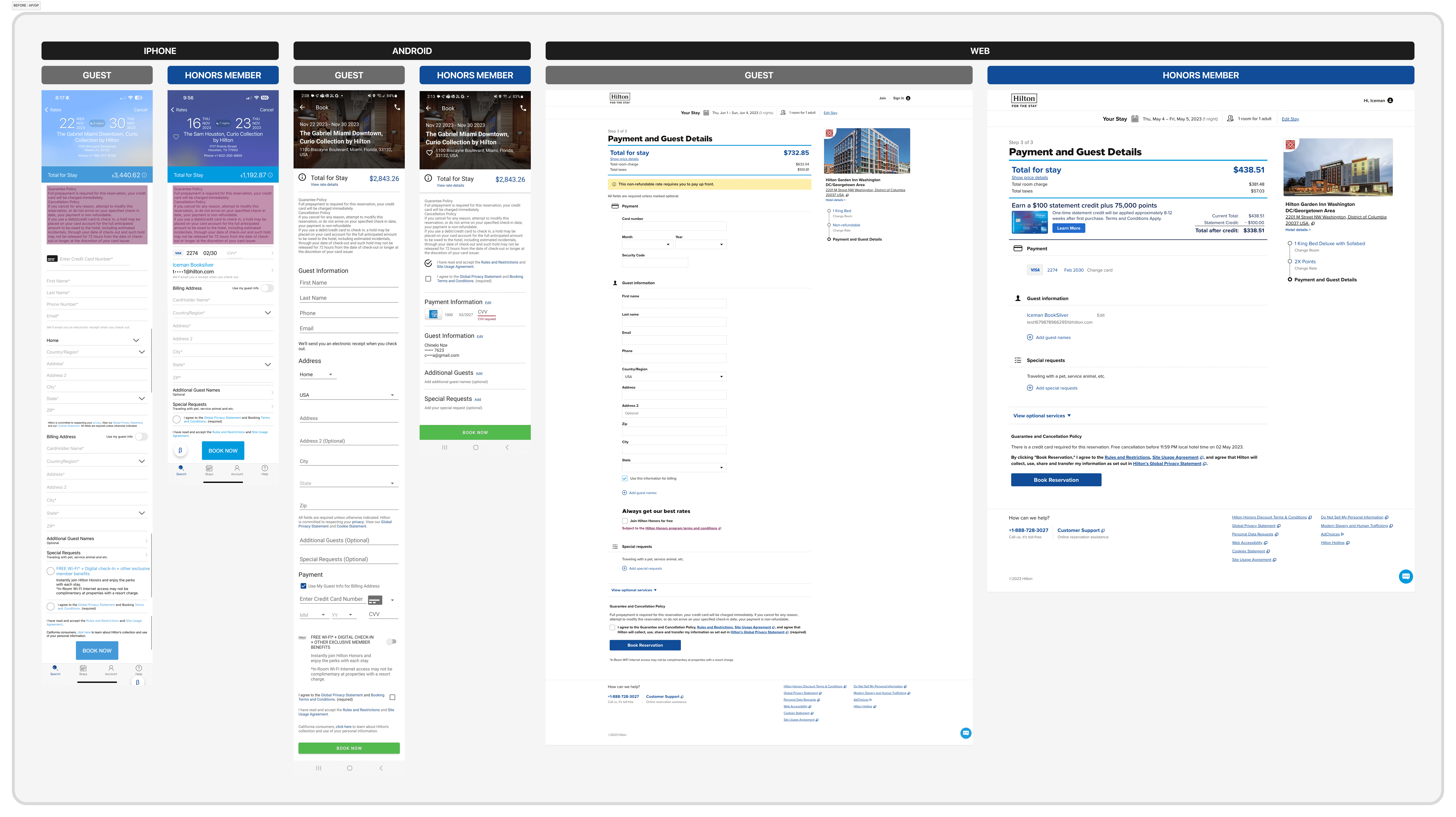
Before - No support for flexible payment options
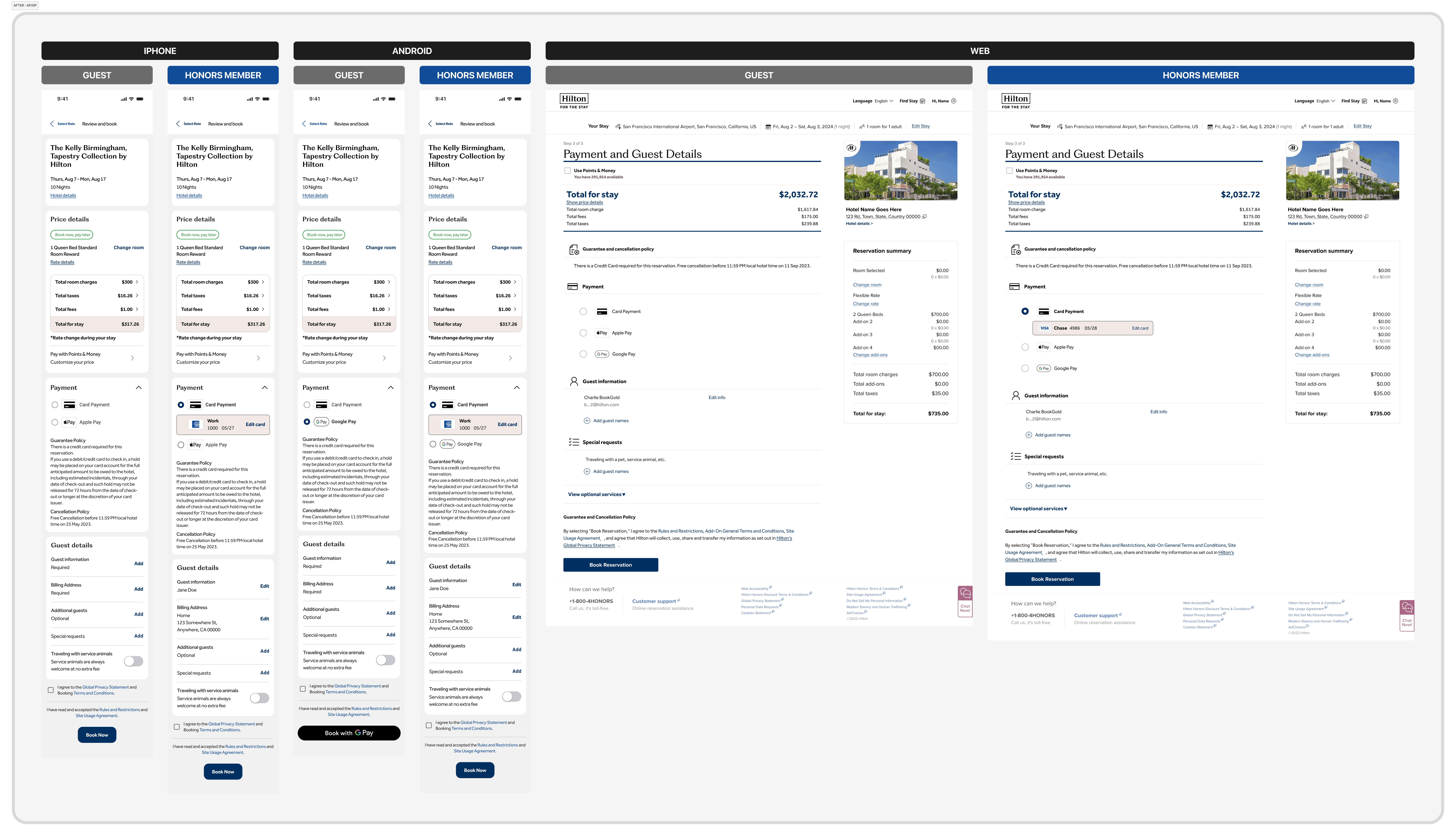
After - Apple and Google Pay available as payment options
Key design decisions
Introduced digital wallets as native options within the existing payment selection model rather than standalone flows
Designed a flexible integration pattern that could support additional payment methods in the future
Ensured parity across mobile and desktop experiences while respecting platform-specific interaction patterns
Maintained clear fallback paths to traditional card payments to preserve trust and reliability
Future considerations
The integration framework was designed to support additional payment methods, including PayPal, Klarna, and other buy now, pay later offerings, without requiring significant changes to the core checkout experience
Checkout: saving and reusing payment information
Persisting payment methods from Checkout to Wallet
Previously, payment details entered during Checkout were not consistently saved or surfaced across guest experiences, and mobile flows differed across platforms. The redesigned flow made saving payment information explicit and intentional, while introducing a single, consistent mobile pattern shared across iOS and Android. This reduced repeated data entry and strengthened the connection between Checkout and Wallet as part of a unified payments system.
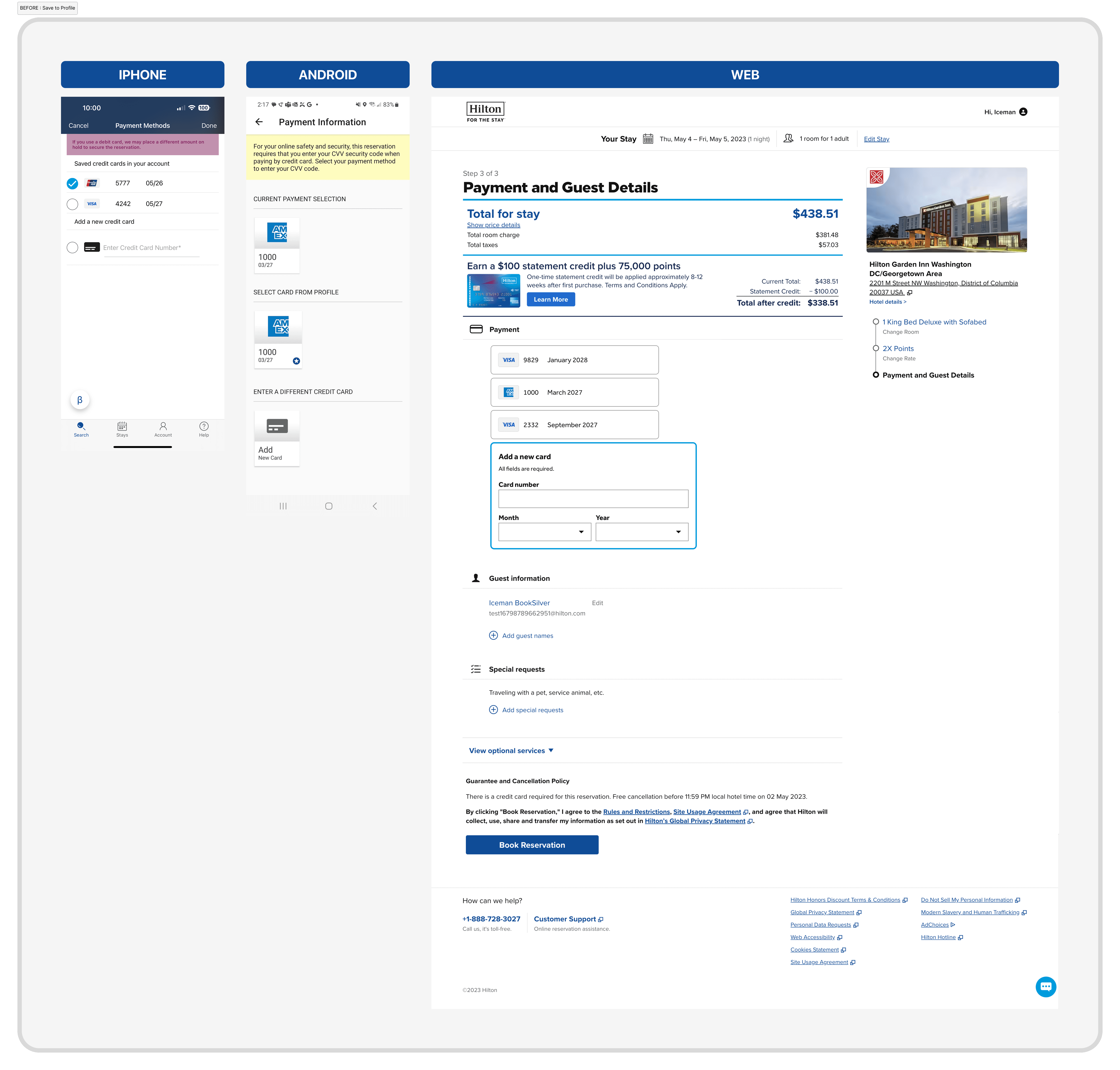
Before - No way to save a new card
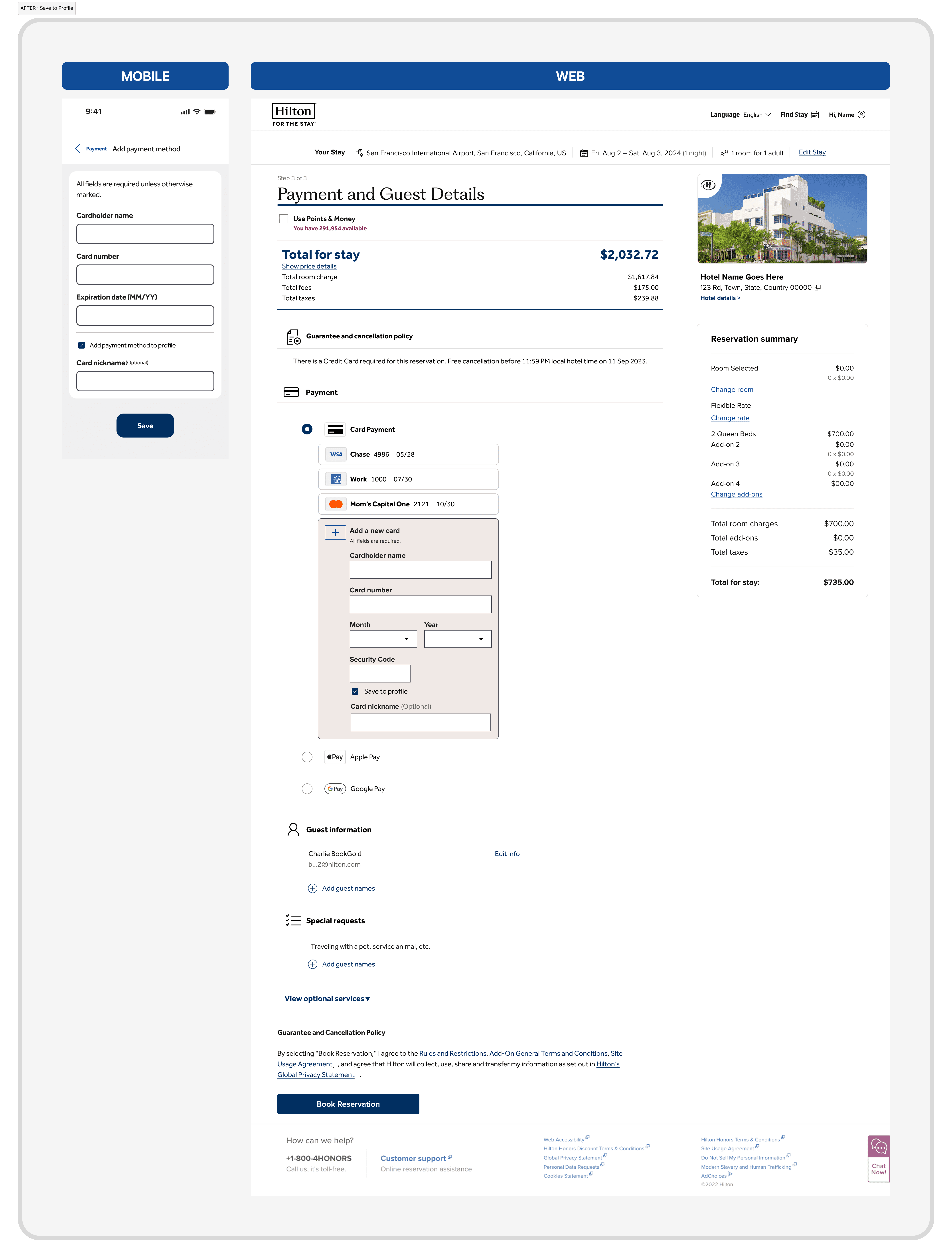
After - Save payment methods back to the member profile
Key design decisions
Added a clear option to save a newly entered card to the guest’s profile during Checkout
Introduced optional card nicknames at the point of saving to improve recognition and reuse
Ensured cardholder name and associated details were persisted consistently to Wallet as part of the shared payments system
Reflected saved card nicknames immediately in Checkout to reinforce continuity across surfaces
Wallet: improving payment method clarity and control
Making payment methods easier to understand and manage
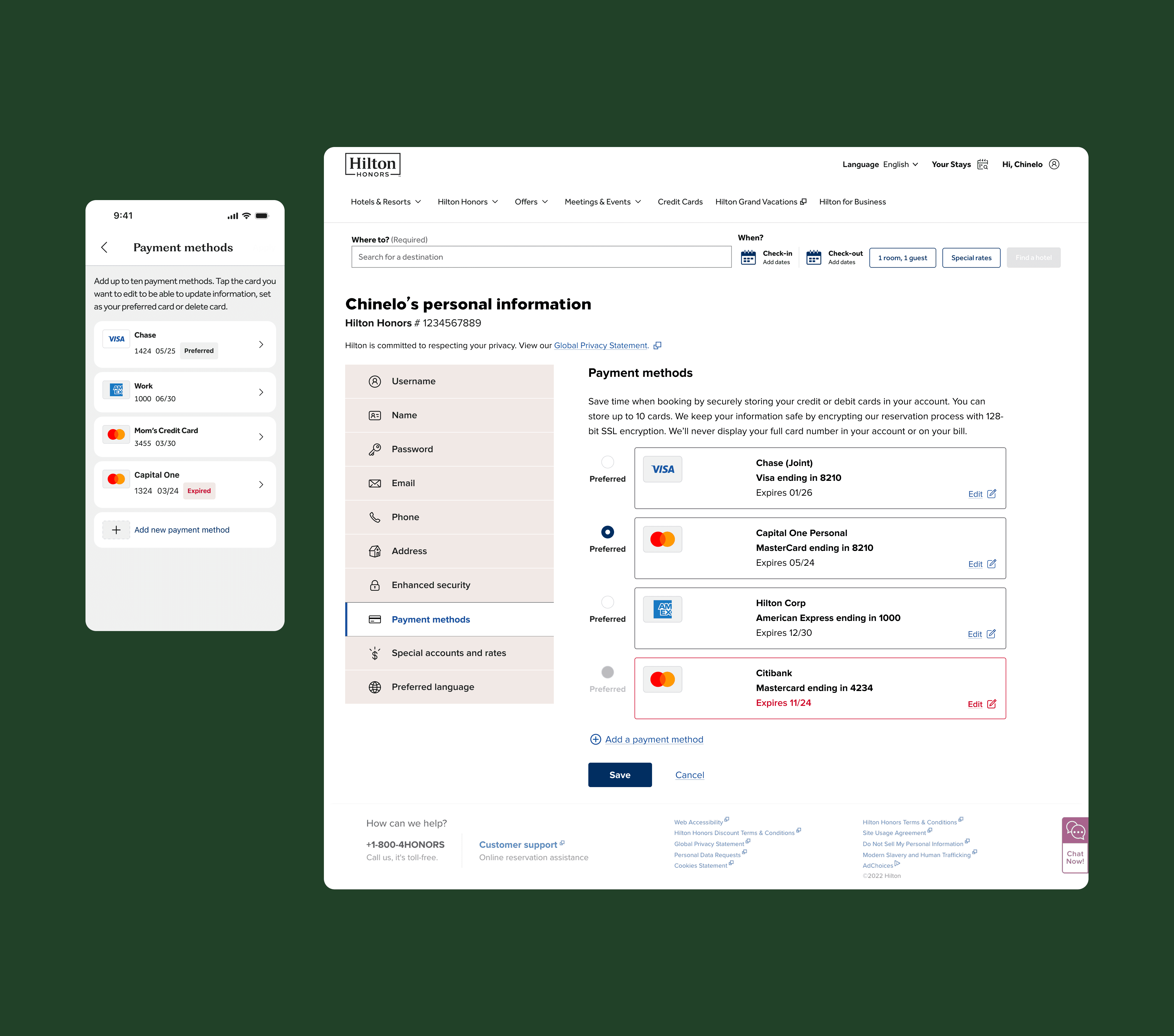
Wallet updates focused on reducing ambiguity and increasing confidence when guests managed saved payment methods. The changes improved usability while preserving alignment with backend systems, enterprise data models, and compliance requirements.
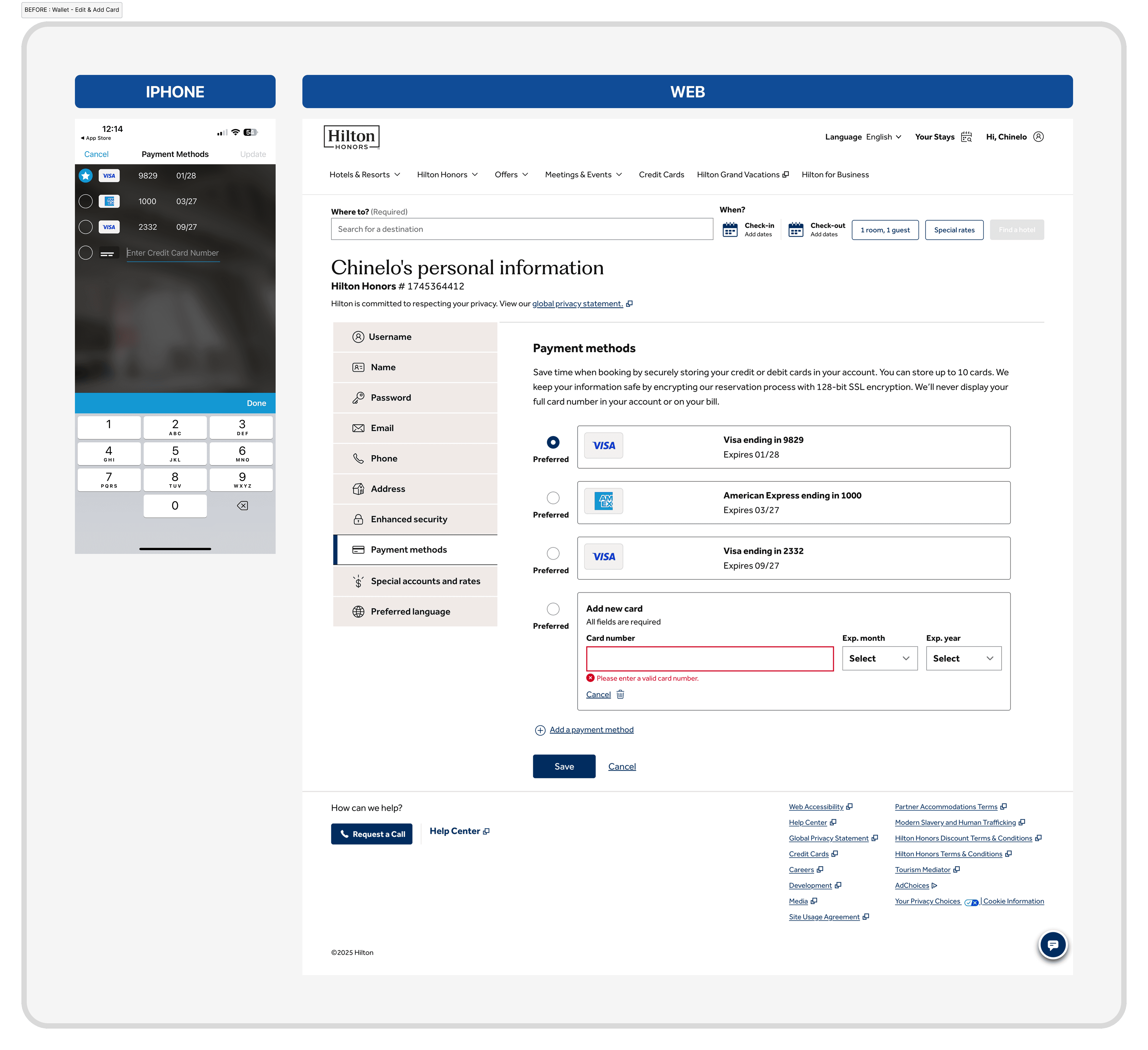
Before - No edit functionality, limited card management
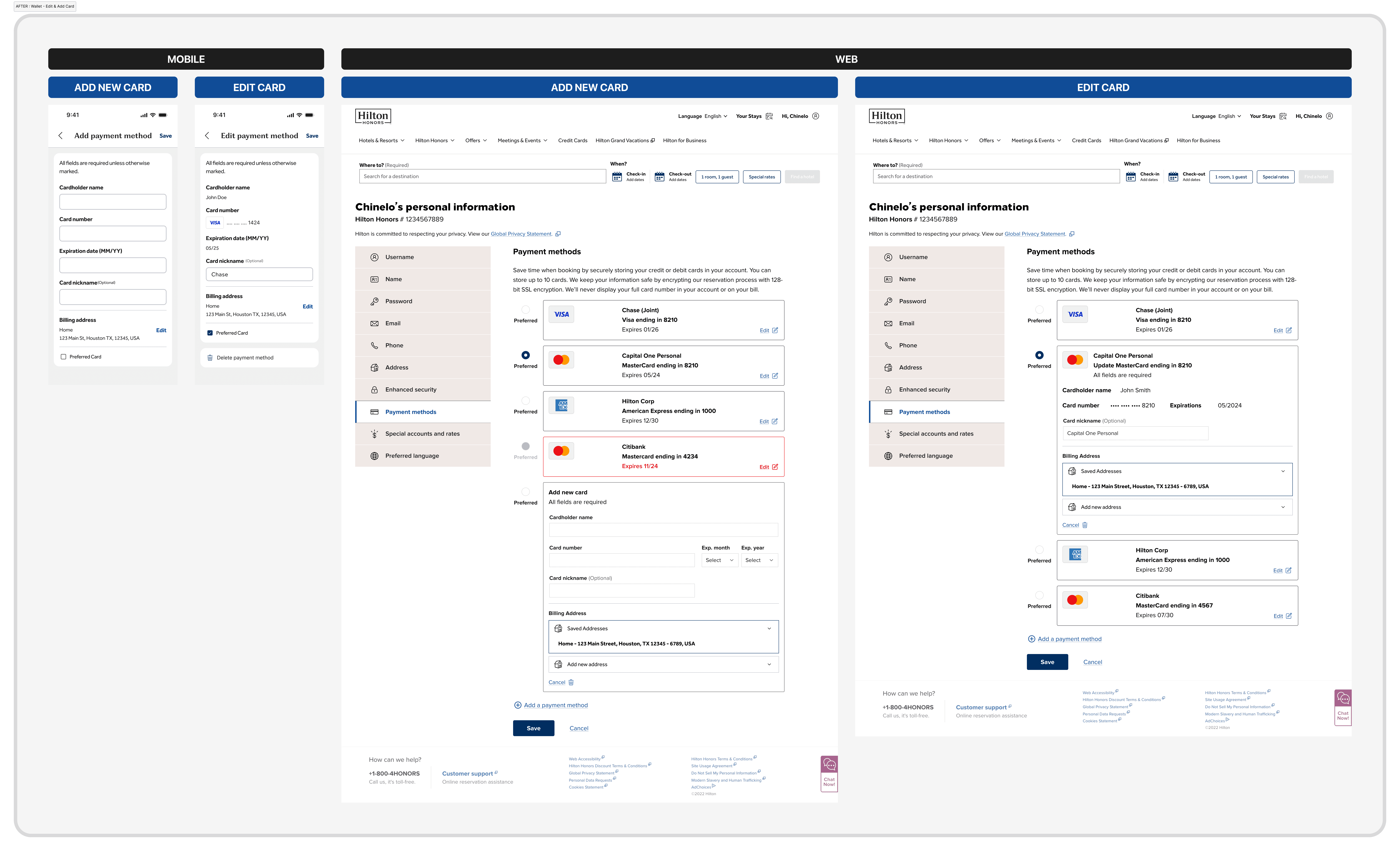
After - Editable payment methods with clearer, more flexible management
Key design decisions
Made cardholder name visible for all saved payment methods to reduce confusion
Introduced the ability to nickname cards, helping guests distinguish between similar payment methods
Structured payment method information to surface the most relevant details at a glance and reduce scanning effort
Maintained consistency with enterprise data models to ensure accuracy and reliability
Wallet and Checkout: aligning billing addresses and address management
Integrating billing address into payment methods
Billing address handling was previously fragmented and unclear across Checkout and Wallet. The redesigned approach treated addresses as shared system entities rather than isolated fields. This created a two-way relationship between payment methods and addresses, reducing duplicate entry and improving consistency across Checkout and Wallet.
Before - No mapping to billing addess
After - Billing addresses linked directly to saved payment methods
Key design decisions
Linked billing addresses directly to saved payment methods
Allowed guests to select an existing address from their address book when adding a new card
Ensured newly entered billing addresses were automatically saved back to the address book
Increased the number of addresses guests could save and introduced address nicknames to support easier recognition and reuse
Expanding and improving address management
Previously, guests were limited to saving only a Home and Work address. As addresses became central to billing and payment selection, this limitation created friction and reduced flexibility. The address book was expanded to support multiple saved addresses and clearer labeling, enabling guests to manage billing information more confidently across Checkout and Wallet.
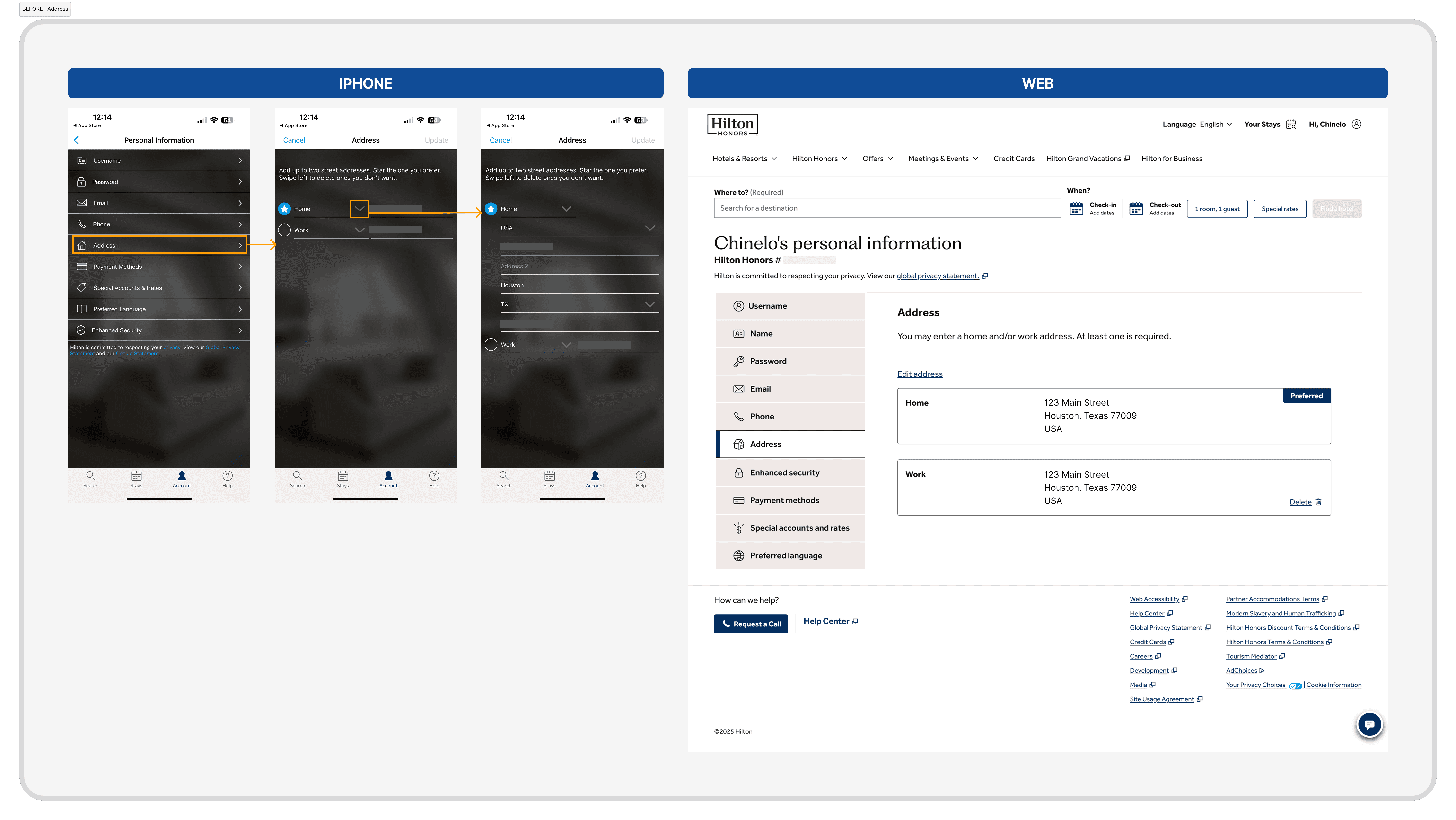
Before - Limited to Home and Work addresses
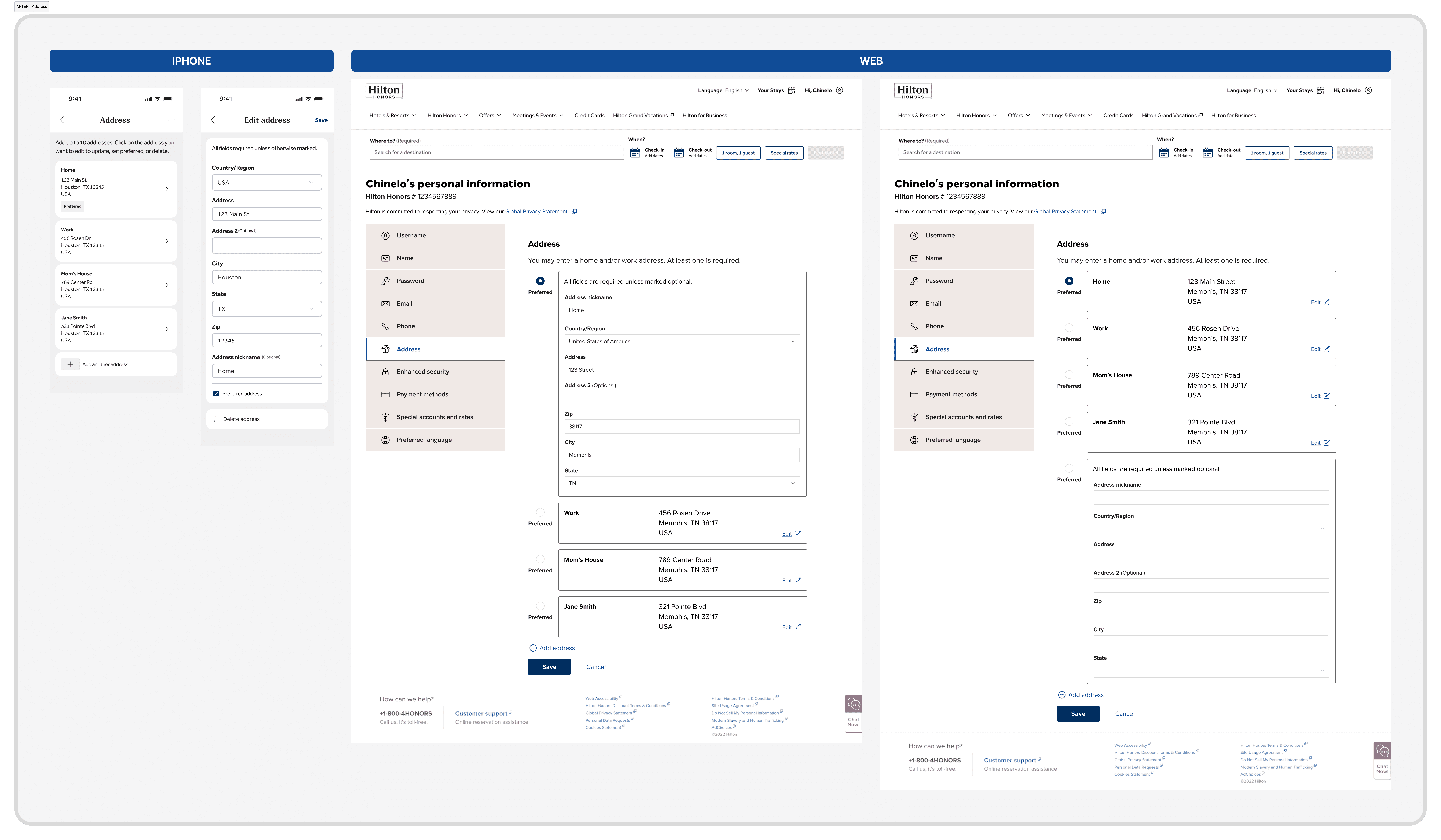
After - Multiple saved addresses with custom nicknames
Key design decisions
Expanded the address book to support more than two saved addresses
Introduced address nicknames to help guests distinguish between similar locations
Ensured address nicknames surfaced consistently wherever addresses were selected
Maintained alignment with enterprise data models to support reuse across Wallet and Checkout
Making billing information explicit during Checkout
To reduce uncertainty during booking, billing address information was surfaced more clearly within Checkout. Guests could see exactly which billing address was being used, select any address from their address book, and save newly entered addresses for future use. This reduced confusion during payment submission while reinforcing continuity between Checkout and Wallet.
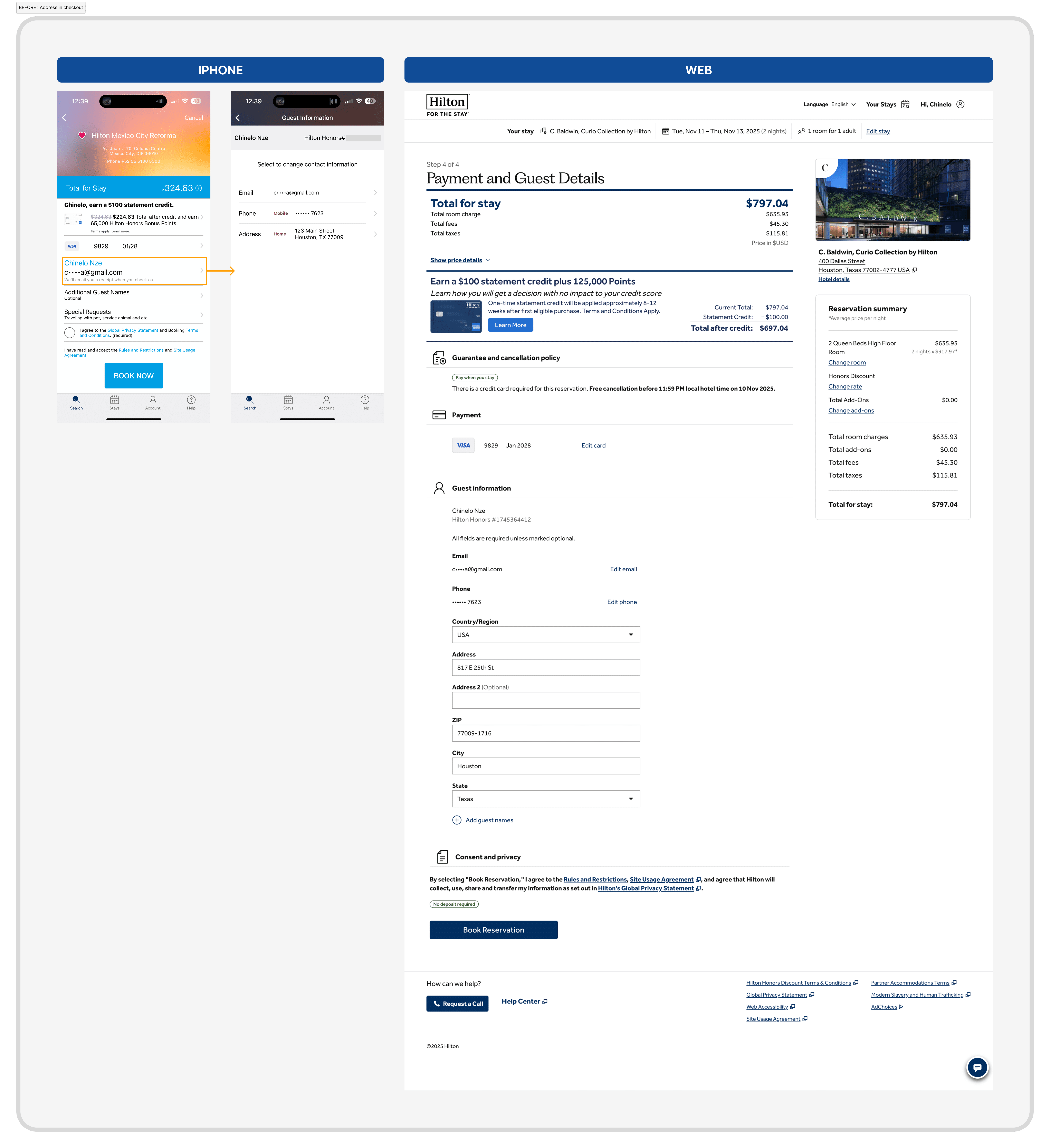
Before - Unclear what address referred to, defaulted to home address
After - Billing address clearly surfaced with ability to select, edit, or save addresses
Key design decisions
Explicitly displayed the billing address associated with the selected payment method
Allowed guests to select any address from their address book as the billing address during Checkout
Enabled guests to add new billing addresses directly in Checkout and save them back to their address book
Ensured changes made during Checkout were reflected back in the guest’s profile and Wallet to preserve consistency
Clarified the distinction between guest contact information and billing address to avoid confusion
Final solution overview and walkthrough
The final solution unified Checkout and Wallet into a single, cohesive payments experience. Guests manage payment methods and addresses once, then reuse them confidently across booking flows, with information staying in sync across web and mobile.
Rather than introducing new mental models, the work reinforced shared system behaviors across surfaces. Payment details feel persistent, predictable, and trustworthy at every step, from managing saved methods in Wallet to completing a booking in Checkout. Updates made in one place are reflected everywhere, reducing uncertainty and repeated effort.
Below is a high-level walkthrough of the final experience, highlighting how Checkout and Wallet work together as a unified payments system.
Checkout walkthrough (Web)
This walkthrough shows how guests complete a booking using saved or newly added payment methods.
During Checkout, guests can select a card or digital wallet, clearly see the associated billing address, and make updates without leaving the flow. When a new card or address is added, guests can choose to save it to their profile, ensuring it is available for future bookings.
The experience balances speed and flexibility while remaining tightly connected to Wallet, reinforcing trust and continuity at a critical moment in the booking journey.
Wallet walkthrough (Mobile)
This walkthrough shows how guests manage payment methods and addresses in Wallet.
Payment details are structured to surface the most relevant information at a glance, including cardholder names, nicknames, and linked billing addresses. Guests can add, edit, and distinguish between multiple payment methods and addresses with confidence, knowing those selections will be reflected consistently across booking experiences.
This flow highlights Wallet’s role as the persistent foundation for payment management across platforms.
Outcome and impact
This work shipped in phases. The Apple Pay and Google Pay integrations launched and performed strongly, while the broader Wallet and address management improvements were fully designed and delivered through detailed specifications and engineering handoff prior to my maternity leave. Remaining enhancements are pending prioritization across product and engineering teams.
Impact from launched work
Successful rollout of modern digital wallets
Apple Pay and Google Pay launched across 300+ properties, expanding payment flexibility and aligning Hilton's checkout with modern guest expectations.
Improved checkout confidence and completion
Introducing familiar, device-native payment methods reduced friction at a critical moment in the booking flow and supported faster, more trusted transactions.
Impact of delivered designs when implemented
Greater clarity and control
Guests can clearly identify saved payment options, assign nicknames, and confirm the correct billing address, reducing ambiguity during checkout.
Reduced payment errors and friction
Explicit cardholder name and billing address handling aligns with issuer verification requirements, helping reduce failed or declined transactions.
Resolution of long-standing UX gaps
Address logic was previously fragmented across Checkout and Wallet. This work establishes a single, coherent model for managing addresses across the system.
Support for complex, real-world use cases
Simplifies multi-card management and scenarios such as booking for others or switching between personal and work payment methods.
A scalable foundation for future growth
The modular payments and address framework enables additional payment methods and wallet enhancements without introducing fragmentation or rework.